How is my company really performing?
Which conclusions about earnings, economic performance and development are supported by the available evidence?
Corporate Performance connects financial, earnings, procurement, operational and commercial perspectives into an evidence-based management view. It examines what has changed, which causes can be supported by evidence and where management attention is required. Missing evidence, assumptions and limitations remain visible — so decisions are not based on a plausible guess.
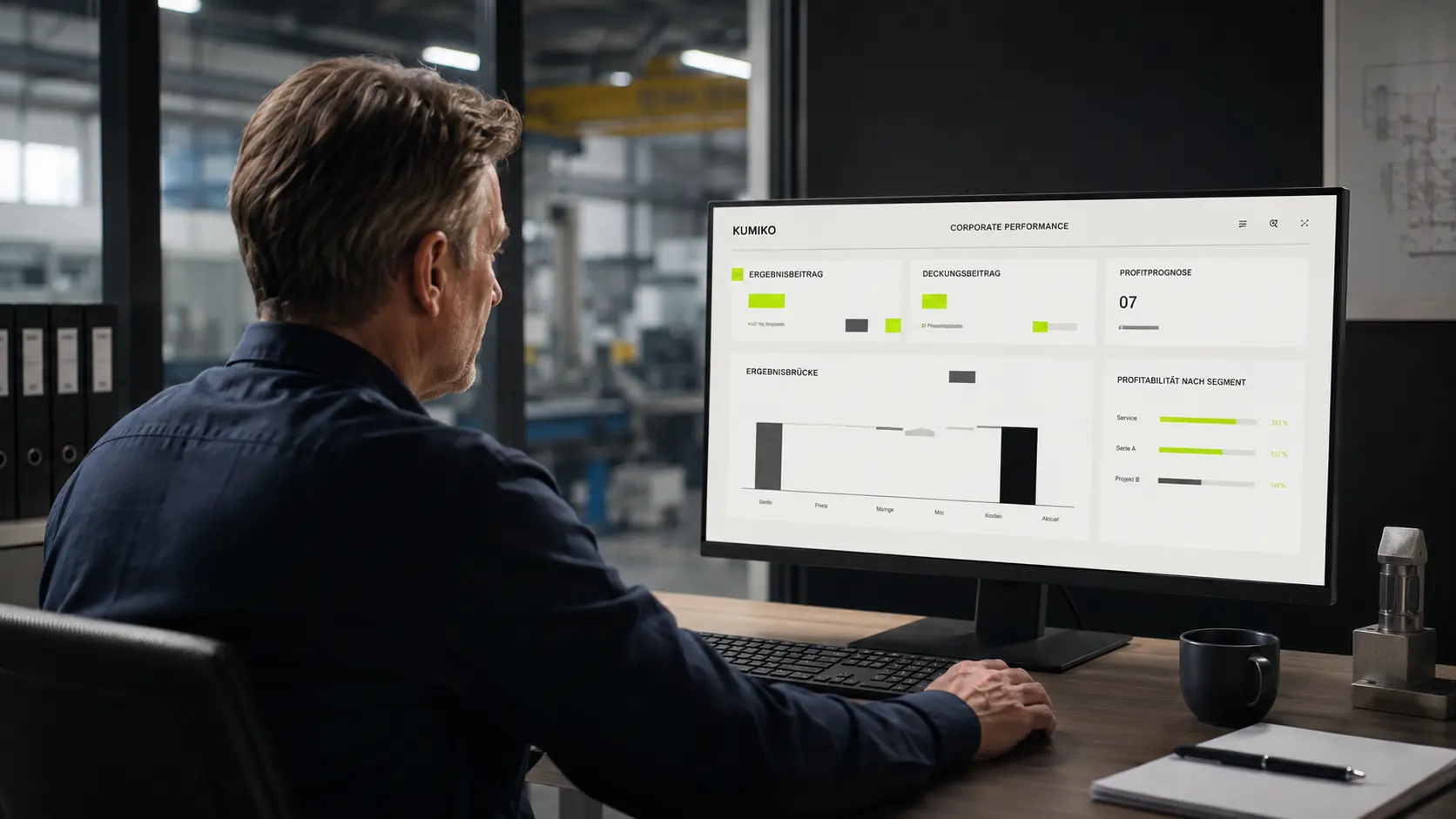 Illustrative concept · synthetic data · not product interface
In many industrial SMEs, the decisive information is spread across ERP, finance, cost accounting and Excel. Reports show results, but rarely the robust relationships behind them.
Corporate Performance addresses precisely that gap: the questions left unresolved between the monthly close, controlling, procurement, sales and operational performance — yet still requiring a management decision.
Corporate Performance starts with the management question, not with a dashboard.
Which conclusions about earnings, economic performance and development are supported by the available evidence?
Which changes can be explained, which causes remain hypotheses and what evidence is missing?
Which customer, product, procurement, cost, operational or commercial effects matter to performance?
Which issues are material enough to warrant a management decision or further investigation?
Which options follow from the supported situation — without transferring decision authority to the system?
Which data gaps, assumptions or methodological limitations prevent a robust conclusion?
Where the evidence allows, Corporate Performance can place decisions and observed economic developments in a traceable context.
This synthetic example shows the analytical logic. It is not a product interface and contains no customer data.
The conclusion is linked to approved revenue, price and volume data and to the calculation applied.
STATUS · SUPPORTEDThe valid BOM version is missing. The system therefore produces neither a substitute value nor a plausible causal story.
STATUS · EVIDENCE PENDINGEach pilot has a clearly bounded analytical scope. Every conclusion remains linked to its data basis, calculation, data quality and methodological limitations.
Establish a robust basis for the financial position and relevant earnings measures.
Understand where earnings are generated and how customers, products, projects or other relevant views contribute.
Examine procurement and supply-chain developments while distinguishing them from economic effects that have not yet been robustly established.
Place operational performance, capacity, utilisation and delivery-related changes into management context.
Examine price, volume, mix and other commercial developments systematically and connect them to their evidence.
Bring relevant findings together, make priorities and missing evidence visible and structure the basis for management decisions.
The Corporate Performance Cockpit brings relevant findings, changes, evidence status and management attention into one view. Its purpose is not to display every available metric, but to make visible what changed, what can be robustly explained and where a decision or additional evidence is required.
Conclusions remain connected to their evidence status. An open question remains open when the basis for a robust answer is missing.
Illustrative view of the Corporate Performance Cockpit. Content shown is synthetic or illustrative and does not represent customer data.
For strategic assessments, transactions, due diligence, restructuring or other clearly bounded decision situations. Corporate Performance structures the management question, connects relevant evidence and makes findings, uncertainties and decision requirements visible.
For recurring management steering, for example after a new monthly or reporting-period close. New information is placed into the existing performance context, changes are examined and relevant management attention is updated.
Corporate Performance replaces neither management nor the accountable functions. The system investigates, explains and structures options for action. Decisions, approvals and accountability remain with the responsible people.
See where earnings are generated and which customers, products or projects are economically critical.
Trace margin movements back to price, volume, mix, material, cost or utilisation.
Expose data gaps, assumptions and methodological limitations before they become a management action.
Investigate recurring relationships systematically instead of creating another Excel version for every question.
Material conclusions remain linked to their data source and calculation.
The same approved basis is expected to produce the same calculated conclusion.
The system investigates and recommends. Accountable people decide and approve.
When the evidence is insufficient, the result remains explicitly open.
A pilot starts with one clearly bounded management question. This may concern an earnings or profitability development, a procurement or operational change, or a commercial performance question. Which areas can actually be examined depends on the mandate, available evidence and approved data scope.
Scope, data coverage, security requirements, methodology and expected decision value are agreed before work begins. Steffen Kuhn leads the engagement for KUMIKO and remains accountable for customer coordination and human approvals.
Current status: guided pilot programme. There is not yet a reference application using live company data. Company data is processed only within an explicitly approved mandate and after the required technical, contractual and data-related approvals.